Philosophy, history, political science, international studies, economics, current events, technology, education, and personal matters.
Tuesday, April 3, 2012
Damn Good Joe
The world lost a damn good dog on Monday. I can't cry myself out. I have never lost anything that I loved so dearly. I guess I'm lucky that in almost 40 years, my biggest loss so far was a dog. I guess I should count myself lucky to spend 15 years with such a great animal. But the only things I feel right now are sadness and the temporary numbness that your body grants you right before it sends the pain signals again.
In 1998, I was finally on my own. The Marine Corps had forced me to live in tight quarters, never alone for a minute, for four years. But they didn't pay me enough to build up a savings account, so when I got out I lived with roommates and then with my parents. Finally, after 18 months of civilian life, I had saved up enough for an apartment. Within a month of moving in, I was ready for a dog.
The humane society had setup a puppy adoption on the sidewalk of a shopping plaza. I went down there just to look around, and I wanted to be picky about the dog I adopted. I was thinking of a boxer or a bull dog, and wanted to name it Chesty after a famous Marine General. I know: cheesy.
I can't tell you why I stopped stopped to look at Joey. I don't remember much of that afternoon. All I can say is it felt right. We made a connection, I paid the tab, and took him home.
Joey was enthusiastic and fearless. He sniffed my apartment down and pee'd on every tree in the yard. Twice. I was tired, so I called him into bed and we took an afternoon nap together. Then we went to my parents house to show him off, and he was instant friends with my parents dog (who I eulogized on this blog here.) It was the perfect first day.
A few weeks later I brought a girl home for our second date, and she instantly fell in love with Joey. And of course he fell in love with her. He never had an enemy, and really loved the ladies. I had my doubts, but he insisted I keep her around. Her name was Rachel.
I remember one day that Rachel wanted me to go to her family party where all her cousins and aunts/uncles/grandparents, etc would be gathered. I spent every second I could with Joey, so I took him along. The cousins were playing baseball and wanted me to play. My team was batting first, and soon I was up. I told Joey to sit-stay (he was usually obedient.) I got a hit and ran to first. When I ran, Joey ran. We were both safe at first. Next batter gets a hit, we both run to second. Rachel's family thought it was hilarious. We scored, and eventually played center field together. That was Joey in a nutshell: having fun and making friends.
Nobody could poop like Joe. He was infamous for quantity and quality. We would take him to a dog park or to my parents and bet on if he would poop 3 or 4 times in the space of a few hours. When my parents moved into a new house, he ran around the new huge basement and then laid a massive poop on a carpet scrap. He's lucky it was on the scrap and not on the newly installed carpet--or did he plan it that way?. After I married Rachel (Joey's idea) we bought a house. We brought him over to to check it out. He ran around the backyard for a while peeing on everything. Then he came into the house to sniff around...and to lay a massive poop in the center of the living room. Rachel swears she can still see the dent it left in the hardwood floor.
One day Rachel's sister ended up with an abandoned puppy that she couldn't keep. Rachel took one look at the puppy and insisted we take her in. I was skeptical, and let Joey decide. Joey let the little Cujo jump all over him, bite him, take his bone, and bark in his face. Then he licked her silly and gave me a nod. She stayed. I'm pretty sure Joey regretted that decision, but he would never admit it. Nina turned out to be crazy, selfish, messy, and loud. But she was his sister and he remained loyal to her. I have a picture of him licking and snuggling her moments before I took him to the vet, 14 years after adopting her. In his last few months, she was confined to a cage at night due to some accidents she was having, and I would find him in the morning in front of her cage, keeping her company.
Sometimes I am not as patient as I should be. Joey had his quirks that would really get me upset because no matter what how loud I yelled, he was still quirky. I'd feel guilty later and apologize to him, and he always forgave me. He was quick to forgive, but he didn't let his guard down. When he saw my temper rising, he avoided me. He trained me to use something other than anger when communicating with him. It took years, but I'm finally making progress. Sometimes Nina would cross a line trying to dominate him, or would try to take his food and he would bare teeth and back her off.
He put up with a lot of shit, but he wasn't a pushover. He drew his lines and stood his ground when it mattered to him. Joey was true to himself in a way that I may never emulate. And all the while, he was this humble, patient, generous dog who everybody loved. He always wanted to play, but he didn't push the issue when I was dog tired. He always wanted affection but if you told him to go lay down he would, and wait patiently for your love to come to him. He always wanted what you were eating, but he didn't beg. He would give you the saddest eyes you've ever seen, as if he had never eaten, but he wouldn't make a big thing of it or be disobedient.
Rachel and I had a child. Like the puppy, our first child wanted to climb on him and chew on him. He would just lay there and let her climb and drool. When she got bigger, she wanted to ride him. That wasn't going to happen, but he was gentle about it. He didn't run off or nip or buck. He simply laid down, let her bounce on his back till she got bored, and then gently disappeared. Nina was nowhere to be found during any of this. She learned to hide, slink away, and stay scarce.
Rachel and I had a second kid, and this one was all boy. He had a strong grip from the day he was born, and would pull tails and ears and fur. Still, Joey was a good big brother, always gentle and usually available for the abuse. Eventually, the boy grew up into a kid who understood how to play with a dog properly, and they were soon buddies.
On New Years Eve 2004, Nina got spooked by fireworks. She hopped the fence and ran off. We looked everywhere for her that night and couldn't find her. We kept looking for her day after day, without any sign from her. Joey obviously missed her, despite the fact that she took up space, attention, and food from him, and tormented him daily. We finally found her after two weeks, and when I brought her home there was a lot of excitement and tears. But no one was happier than Joey. He tried to lick all the fur off of her, and they fell asleep that night forehead-to-forehead. He could have been excited while she was gone because he had the house and the food and the attention all to himself, but instead he was happy to have his nasty sister back. That's Joey: All heart.
Joey had some nicknames. "Joe-dog". "Jose" (the Mexican in-laws came up with that.) "Jose-Martin" (I don't know how that came about.) "Butts-and-guts" (Joey filled out a little because he was half chow, and he was always hungry, so Rachel came up with that. There's even a song.) "Senor" (another mexican thing.) "Patches" because when he shed, his Chow undercoat would come out in clumps. Sometimes his sister was "Itchy" and he was "Scratchy", like the Simpsons cartoon. In the last two years of his life, he developed this panting habit that was loud and annoying. The vet said it was normal, but I would often ask him to stop. We joke that it sounded like a train, so when he started up his panting, I'd ask him to pull the train into the station. The panting earned him the name "Huff-and-Puff" (which sometimes turned into "Huffelpuff" after we read Harry Potter.) I think a nickname is evidence that you have personality, and it means people care about you. Obviously, Joey had a lot of personality and a lot to love.
Joey used to run with me. A few years ago, he started falling behind on runs. I was sad to lose a runnning partner, but he obviously had a lot of life left in him so I didn't think much of it. Last year, it got to the point that he couldn't walk for more than a few blocks. That's when I went into denial.
He started to have trouble standing up on the hardwood or tile floors, but that was where he preffered to lay. I bought him a top-of-the-line dog bed that he could easily get into and stand up in, but he preffered the cool, slippery floors. That, and his sister kept stealing his bed instead of using her own.
And then one Saturday morning, he couldn't get up. He kept trying, but his back legs just wouldn't push. So I helped him up and led him to the back door. He seemed okay, but when he had to step down to get outside, he stumbled like a drunk. He took two steps onto the deck and emptied his bladder. It was the most undignified thing I had ever seen, and I immediately snapped out of my denial: Joey was in bad shape. I carried him back into the house and tried to feed him, but he wasn't hungry. Joey not hungry? Oh shit.
I cried like a baby, right then and there. I couldn't hide it, and I couldn't speak clearly to explain to my wife what was wrong. All I could do was cry for Joey. I immediately made an appointment for the vet, but it took a while to compose myself enough to leave the house. My son went with me. The vet looked him over and diagnosed advanced arthritis. He said there wasn't much he could do, but would try an anti-inflammatory and a pain-killer. He also said that even with that, we probably only had a few more months. When he left the room, my son asked me what the vet meant, and I had to explain that Joey would soon be put to sleep, and how, and why. I explained that in the wild, his lack of mobility would have already killed him, but that we are able to prolong his life a little longer. But I also explained that for Joey's sake, we would have to end his suffering when there was nothing more we could do for him. All that time, I was crying.
The medicine helped a little. Joey moved around a little better. I followed up with the vet and asked if more medicine would help, but the vet sadly shook his head. I went online and tried to find anything that would give us some hope, but everything I read said that we were doing all we could do. Even surgery wouldn't help and would only cause more suffering for the animal.
And one of the articles made it clear: it is more for selfish reasons that we would delay euthanasia at this point. Once the animal has lost a significant quality of life, it isn't fair to them to keep them around. I thought I was delaying euthanasia because that was the right thing to do. But I came to realize that the Joey who was once so full of enthusiasm and affection was now a very inactive and sometimes irritable guy. He still ate his share and would let you cuddle him, but his heart wasn't in it. A couple of times recently I laid on the floor to cuddle him and he tolerated it for a while, then got up and went to be alone.
After a month, he went in for a followup and they noticed that the anti-inflammatory was doing damage to his stomach and kidneys. They took that away and left him on just the opiate. He started needing help to stand up several times a day. It was clear what needed to be done. I started researching euthanasia options. The research allowed me to delay the decision.
I finally made the decision, but couldn't make the appointment for several days. In the middle of the work day last week, I went down to my car and called the vet. We made the appointment, I hung up, and then I cried. That sucked. I went home and told the family. We all cried. That sucked. But then we all went to work on making Joey's last days as great as they could be. Everytime I walked past him, I said his name and gave him a pat. I brought home treats and let him eat whatever he wanted, though his appetite wasn't quite there. On Sunday, I threw a party for him. The kids made signs for him, and we had balloons, and he got his own hot dog.
That last night, we all cuddled around him. I was planning on taking him to the vet alone, but the whole family wanted to be there. It was a school day, but this was more important. A great dog was going to leave us. Their brother and best friend. They understood the whole thing and were ready for it, so I said they could be there.
That morning, I had to help him to his feet. I carried him outside to the grass, and let him enjoy his yard one last time. We sat around the living with him and I told the kids stories about a younger, faster Joey. The dog who kissed Rachel for the first time before I had a chance. The dog who tolerated a naughty puppy and two curious toddlers. A dog who plays baseball, and swims like a champ, and poops like no other dog. And then it was time to go.
I called him to the car. He took his time, and I let him. He sniffed, and he stalled because he never liked car rides. But I didn't force him. I let him come to the car on his own, and I lifted him in. In the parking lot at the vet, I set him down and let him take his time walking in. I hoped that it gave him some dignity to be able to walk at his own speed, on his own legs, into the vet.
The staff made sure that we understood everything. Then the vet explained that she would take him in the back, prep his leg and put in a catheter and then bring him back to us. She led him out, and we waited. After a few minutes, we heard huffing and puffing outside the door and knew it was our dog. Rachel joked that the train was pulling in. We chuckled a little, and encouraged him to come on in.
There was a blanket on the ground for him to lay on. The vet went to get the final injection while we spent a last few mintes with him. My son gave him a biscuit. we all pet him and told him the sweet nothings that came to mind. The vet came back in and asked if we were ready. We had been saying goodbye for days, so we couldn't be more ready to see him finally at peace.
It happened way faster than I expected. She slowly pushed the plunger and he suddenly relaxed like he was going to sleep. He let out a final sigh, she listened to his heart, and said, "He is in Heaven now." It looked like he was asleep. It was a dignified end to a life well-lived. We were then left alone with him.
We cried. Holy shit did we cry. My son, in mid cry, remarked that he had never seen me cry so hard. We didn't want to leave, but we new that eventually we had to. I don't know how long we stayed, or how we decided to leave. But eventually we left him there alone on that blanket in the examination room for the vet staff to deal with.
It was hard to drive home without crying, but someone had to be strong enough to get us safely home. Once in the house, I cried some more. And then I cried some more. My daughter was ready for school, but my son sat with me on the back porch and we cried together and talked about life, and death, and dogs, and medicine, and Joey. And I think we cried a little more. Then we cleaned our face, I took him to school, and I went to work.
I kept it together at work, and got through the rest of the day. Then I went home and cried a little. I went numb, watched TV, ate dinner, worked a little, and got into bed. And then I cried again.
That night, I had trouble sleeping because I wondered how they dealt with the body. We left around 10 am. Did they carry the body out while the waiting room was full of people? Did they gently lift him onto a cart? We paid extra to get his ashes back. How did his body get to the crematorium? Was it treated with dignity throughout the process? How would we know we actually got his ashes, and not just some random ashes?
This morning I woke up numb. I thought perhaps I was cried-out. But after everyone had left, as I was preparing to leave, I look at his food dish sitting there and I cried hard. I made gutteral noises I had never made before. Everytime I thought I was done, I started crying harder and couldn't stop. It was 20 minutes before I had enough composure to leave the house.
While driving home tonight, I cried a little. I talked to Joey, and told him how I planned to honor his memory. When I pulled into the driveway, I remembered how he would be at the fence to greet me on most spring days like this, with his curly tail wagging and his multi-colored toungue hanging out and a smile on his face. I cried again.
My son and I ran some errands, and played some tennis. And then I sat down to write this, and I have cried a hundred times while writing. I miss that dog so much. I know that I made the best decision for him, and that ending his pain was the best thing to do. I know we had a fantastic life together, and that he lived longer and with more vigor than most dogs. But I still can't get over the fact that I can never cuddle him. Never see that dog face looking up at me without any judgement or resentment. Never call his name and hear the click-clack of his nails on hardwood. Never hear his huff-and-puff to remind me to let him out or feed him. Never come home to find the one person who was always glad to see me and always had time for me--even if I didn't always make time for him.
Joey, you were the best dog that ever lived, and I didn't deserve you. But I am honored that I got to spend so many years with you. My days were brighter with you in them, and you trained me to be a better man. I will never forget you, and I will always strive to be more like you. Thank you, buddy, for being the best friend I could ever ask for. I love you.
Saturday, October 6, 2007
$1 million sent to Iraq
The federal fiscal year ended on September 30th, Fiscal year 2008 (FY2008)started on October 1st. As they tallied the books for FY2007, a unit in the Marine Corps ended their year with a $1 million surplus. That is news by itself; I am sure you have heard it said of organizational budgets, "Use it or lose it." The unit's bean-counters probably knew several months ago that they would end up with approximately $1 million unspent. Therefore, we can assume that this was a planned event and that the General in command here is a risk-taker.
Lieutenant General Richard Zilmer, Commanding General, Third Marine Expeditionary Force (III MEF)
To provide some context for you: The III MEF is a large unit. It is an infantry division, an Air Wing, and a logistical support group (supply, food, medical, communications, transportation, etcetera.) That equates to tens of thousands of people. When I was a fire team leader in a Marine rifle squad, responsible for four Marines, the Commanding General of III MEF was eight levels of bureaucracy above me.
When I read about how the III MEF is relinquishing $1 million of their budget to provide for the safety of Marines in Iraq, I got a warm, fuzzy feeling at first. Believe me, the III MEF could have spent that money in Okinawa at headquarters in the blink of an eye. There is never enough money to go around in a Marine Unit; many units have to trim their training schedule due to lack of funds. When you have thousands and thousands of Marines, aircraft, buildings, acres, vehicles, and assorted other military possessions, a $1 million can get spent in a heartbeat. Moreover, the budgetary powers that be may view this move as a signal that they can send III MEF $1 million dollars less in FY2008 since they didn't need it in FY2007.
The warm, fuzzy feeling did not last long. I got pissed, quickly. It is calendar year 2007. We entered Iraq on March 20, 2003. We still do not have enough protective equipment in Iraq? We are still begging for vehicles that are less susceptible to Improvised Explosive Devices (IED's)? Marines in Iraq have to rely on the charity of other Marine Units in order to be safe and effective?
I do not agree with the sentiment that BushCheneyPowellRumsfeldRice should have anticipated the insurgency. It should not have caught them by complete surprise, but I can understand if they did not send thousands of Mine Resistant Ambush Protected (MRAP) vehicles on the first wave to Iraq. Even so, it should not have taken long for them to realize the value these vehicles would provide.
When did the insurgency start? At what point should we have realized that IED's detonated during convoy would be the greatest threat our military would face in Iraq? I will bet both of those events occurred in FY2003, prior to October 2003. In FY2008, we should be wondering how we are going to get the hundreds of un-needed MRAP's out of Iraq because we sent too many.
I re-read the article again. I noticed a few more words, clarifying the situation. The $1 million is not going to purchase the MRAP's, it is going to fund the transportation of the vehicles from the manufacturer to Iraq. The way I interpret this sentence, the vehicles were not going to get to Iraq as quickly before the $1 million; the III MEF has simply sped up the delivery of the vehicle's.
According to the CIA's World Factbook, the United States spent $2.66 trillion in 2006. I am sure we spent more than that in 2007, if I know my President. God only knows how much we will spend in 2008, regardless of our revenue (we will spend hundreds of billions of dollars more than we receive--don't try this at home.) We have thousands of our finest men and women dying in vehicles unnecessarily, thousands more lose eyes, arms, legs, functions, and capacities; a better vehicle design will preserve lives, limbs, and potential.
WE ROUTINELY RUN BUDGET DEFICITS, WE WRITE BUDGETS IN THE TRILLIONS OF DOLLARS. WE CANNOT FIND $1 MILLION DOLLARS TO SPEED THE DELIVERY OF VEHICLES THAT SHOULD HAVE ARRIVED FOUR YEARS AGO? WHO IS RUNNING THIS CIRCUS?
I think that General Zilmer is sending a message. A unit giving up $1 million dollars is rare; I would venture to say it almost never happens. You don't make 3 stars by being a generous altruist. It takes a savvy political mind, ruthless strategy, and a warrior's spirit. Therefore, his decision is so far out of the ordinary that it will require people to take notice. The message I think he is sending is that if no one else will do the right thing, he will risk his budget and career to do the right thing. I hope that message received in the Pentagon shames them into spending more on safety and less whatever they are wasting our money on this week.
The U.S. Defense Budget was $439.3 billion for FY2007. That does not include money earmarked specifically for the Global War on Terrorism, which was $67.9 billion in FY2006. Therefore, III MEF's $1 million is just a drop in the bucket; that moeny could have come from anywhere with little effect on the big picture. The cost of the MRAP's, especially if you spread it out over four years, is just a few drops in the bucket.
Were the MRAP's too expensive when compared with a tin-foil Humvee. What does it cost when a Humvee is blown by an IED, versus the cost if an MRAP suffers a similar fate? Is it really cheaper to just operate unarmored or after-market modified Humvees?
Obviously, the Humvee contained people. Try to calculate, in dollars, what our nation lost when those people encountered an IED. For the ones who die, we lost the investment we made in their training and education. We also lost the tax revenue they would have generated over a lifetime. You need to factor in tranportation and burial costs, plus payment of benefits to survivors. We won't even try to calculate the potential loss of their talents, ideas, and what their offspring might have accomplished.
For the ones who survive, we need to calculate the cost of their rescue (medevacs are expensive), medical treatment over years, the cost of their VA entitlement, the cost of their lost productivity during recovery and after, and any lost tax revenue we may expect from their new handicap.
Why wouldn't we have Iraq over-run with MRAP's right now? I can only assume it has something to do with money. I guarantee that if you made any conservative estimate on the figures above, you could justify the cost of MRAP's easily. Many city budget have included various armored vehicles which will probably (hopefully) never receive a scratch and only see action in training and parades. Why can't we do the right thing in Iraq? Why do Marine units in Okinawa have to send money to expedite equipment for Iraq that should have been delivered four years ago?
One more set of questions, in case you still think that our military and political leaders are doing a great job. Are the Mine Resistant Ambush Protected vehicles a new technology? Were the IED's a new technology when we first encountered them in Iraq? No, this is a threat that America has been prepared to deal with since World War I, and the technology of protecting troops has not advanced all that much over the years. You have newer allows of steel, but they existed in 2003 when the first IED blew up. You have newer research to calculate the ratios of space, armor, and angle, but we could have done well with the data available in 2003.
Iraq is a safer piece of real-estate in 2007, just as the MRAP's get "expedited" there. These MRAP's will get someone promoted, and maybe the administration will convince some people that this late gesture was, in fact, a great step in securing Iraq's future. I think that is a slap in the face to every spouse, child, and parent of a military hero who lost limbs or lives to IED's in unprotected Humvee's. The arrival of MRAP's in Iraq in 2003 would have meant that we lost much less than the thousands of Americans who died in a vehicle from IEDs. MRAP's in 2003 would also have rendered IEDs almost ineffectual; the insurgents would have had to employ a different tactic. If we had MRAP's as the primary mode of transportation in Iraq in 2004, we would be talking about the war in Iraq in the past-tense. It would be all over now, and we would have Iran cowering at the thought that they were next.
The article that got me all riled up:
III MEF returns $1 million to fund Marines in Iraq
Oct. 5, 2007; Submitted on: 10/05/2007 12:30:34 AM ; Story ID#: 200710503034
By Lance Cpl. David Rogers, MCB Camp Butler
CAMP FOSTER, OKINAWA, Japan (Oct. 5, 2007) -- When III Marine Expeditionary Force ended up with an unexpected budget surplus at the end of fiscal 2007, MEF leaders quickly found a great way to spend it: invest it in the safety of Marines in Iraq.
III MEF returned $1 million in operations and maintenance funding to Headquarters Marine Corps recently to help fund transportation costs to expedite the shipment of new Mine Resistant Ambush Protected vehicles to Iraq.
The MRAP vehicles are built with a special V-shaped hull and raised chassis to provide improved protection from mines and improvised explosive devices, according to Marine Corps Systems Command.
“Getting armored vehicles to Iraq is an urgent requirement that’s got to happen,” said Col. Kevin King, the III MEF comptroller. “This is a bill the Marine Corps must pay, and that trumps plasma screens and other less-essential items. We also had our Regional Contracting Office operating essentially at capacity with existing contract requests without dropping another million dollars on them at the 11th hour.”
III MEF received $4.6 million in late fiscal year 2007 as reimbursement for money spent on Joint Chiefs of Staff and Pacific Command-directed exercises.
“We weighed several options, but it came down to executing against an identified Global War on Terrorism bill vs. identifying new requirements and quite possibly being unable to obligate those funds, certainly not on anything as important as the MRAPs. This issue was discussed with the MEF CG and Chief of Staff and the guidance was that it made sense to give up the funds for a higher priority,” King said.
U.S. Sen. Joseph Biden, Jr., spoke about the importance of getting the MRAP vehicles to Iraq during a congressional proceeding March 28 in Washington D.C.
“That statement that these MRAPs provide four to five times more protection than up-armored Humvees is not my estimate,” Biden said. “That is the judgment of our military leaders.”
Biden added that Gen. James Conway, Commandant of the Marine Corps, wrote a message March 1 to Gen. Peter Pace, Chairman of the Joint Chiefs of Staff at the time, discussing his requirements to have MRAP vehicles in Iraq.
“Multi-National Forces – West estimates that the use of the MRAP could reduce the casualties in vehicles due to (improvised explosive device) attacks by as much as 80 percent,” he said.
III MEF is scheduled to receive five of the MRAP vehicles for training purposes in the near future.
http://usmc.mil/marinelink/mcn2000.nsf/main5/377C5192A08EF2968525736B0018C591?opendocument
Thursday, October 4, 2007
3/3 In Iraq: October 2007
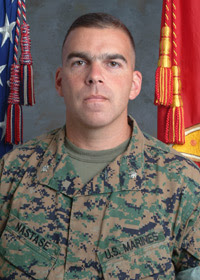
Below is the message from LtCol Nastase, the Commanding Officer of 3rd Battalion, 3rd Marines. Again, Nastase nails a great message that demonstrates progress, hope, and high morale among our nation's finest. These words need to be read by every American, to counter the negativity that we are bombarded with.
When I listen to Bush, I get the feeling that his perspective changes on a weekly basis, depending on who has been to his office the most often. When I listen to the news or read the headlines, I get the feeling that all is lost and America would be wise to tuck tail and run like hell out of Iraq. I feel like Nastase has given us a more balanced view. It is optimistic and upbeat by design, but I also think it is informative and realistic. The message below is not a PR job, it is a well-written message from a Commander to his extended family. I think his words provide a balanced message that admits to hard times and plenty of work to be done, but also describes progress, improvements, and a building momentum among the grass roots in Iraq to live peacefully.
3rd Battalion, 3rd Marines
From the Battalion Commander
1 October 2007
Hello to Friends and Families of “America’s Battalion”,
We’re approaching two months into the deployment and I want bring you up to speed on what's happening. I am well aware that a lot of Americans are now throwing "Al Anbar" around in casual conversation like it’s a new sitcom. We have certainly had our share of attention of late. I guess it’s because everyone is beginning to see the progress that is being made out here. I'll tell you (from someone who has more than a few trips to Al Anbar under his belt), that things are better than I could have ever imagined. Let me try to put what your Marines and Sailors are doing into perspective because a lot has changed over the years.
What's changed? Mostly Iraqi attitude. And the surge has helped.
Attitude. The people out here have simply decided "enough's enough". They've had it with Al Qaeda in Iraq’s (AQI’s) brutality on fellow Iraqis. I'm not exaggerating when I say AQI has literally been terrorizing Iraqis for too long. Most every Iraqi I talk to these days has had someone, sometimes many members of their families killed or kidnapped by AQI. So we are riding the wave of the "awakening" started by Sunni tribal leaders over the last year or so (with no small amount of work by the Marines). This more than anything has changed everything. "The enemy of my enemy is my friend" kind of thing. The realists among them, I think, foresaw the stark difference between a Taliban-like future dominated by AQI versus one of potential prosperity with the help of the Americans. And they’ve turned toward becoming part of the solution.
The manifestations of this in our area really just sprung up in the last 3-4 months and we have worked to expand it. But AQI wasn't giving up without a fight. The Area of Operations (AO) we assumed was only partly "pacified"--with the Sheikhs standing up and their men volunteering to secure their own neighborhoods and joining the police and army. We also inherited areas that remained AQI sanctuary, from where they continued to attack and tried to roll back the clock. What we have essentially done in this first month and a half was clear out those areas, hold them, and allow the fledgling (yet eager) volunteers and Iraqi Security Forces (ISF) to step up. Which brings me to the surge.
Surge. While Baghdad got all the early press, we had a Marine surge in Al Anbar as well. This has allowed us to finally stay in those areas we cleared, and in so doing, give confidence to the fence sitters that we would not leave them hanging as events in the past years forced us to do. Ironically, the "new" strategy is not new for us. What General Petreaus has advocated in Baghdad--get out and protect the populous--is exactly what the Marines did when we first came to Al Anbar in 2004 ("No Better Friend, No Worse Enemy" was and remains the motto). Unfortunately, what started out well back then, soon was overcome by events such as Fallujah I, Fallujah II, and the Samarra Mosque bombing which required us to move forces from cleared areas to address these hotspots. In those early years we didn't have the ISF to maintain security in great enough numbers. The areas we left became sanctuary and killing fields for AQI and eventually we had to go back in and clear again. The extra forces we've had over the last nine months, combined with the awakening of the Sunni tribes, has allowed us to clear, hold, and build. The build is truly key because with the improved security situation, we can now put resources (ie. Money) against the basic needs of the people so that they can actually see tangible results. This gives them incentive to keep standing up and remain a part of the security solution. It has also provided a security and economic umbrella under which the ISF have been able to further grow and mature. In addition, it has led to a resurgence of local governance to manage the daily processes of life here. Still strongly organized around the tribes, we are leveraging that historic organizational framework to forge government institutions you'd be more familiar with (mayors, city councils, etc).
While the enemy continues to try and test us, it has largely been ineffective. But I continually remind the Battalion not to get complacent—there is still some fight left in our foe, although thankfully, it is a fraction of what it was only months ago, and certainly nothing like what we experienced in the last three years. Even the youngest Marines in the Battalion walk this fine line between being ready for anything and treating the Iraqi people with respect everyday. I am very proud of their ability to grasp the fundamentals of counter-insurgency--no easy task despite how much we trained for it. We spend a lot of time patrolling the towns, villages, and farms--a lot of it on foot, up close and personal. The heat is oppressive still (we have yet to have a daytime temp below 100)! But we've had very little problem adapting due to good leadership and planning at the lowest levels. I am repeatedly impressed with the maturity and attitude of our Marines and Sailors. I've watched them enter countless Iraqi homes, collect information, ask about their needs, hand out sweets and school supplies, and treat people with respect. The response from the locals is overwhelmingly positive...they are so thankful that it is us knocking and not AQI. The true sign that we are winning is the kids. I have been all over this area in past tours and rarely saw a kid outside, and even more rarely had any adult male do so much as glare back at me. Now everyone waves, barefoot kids line every street and road when they see us approach--clapping, giving thumbs up and dancing. Even young girls in their flowered dresses are out. Boys (and men too) can often be seen swimming in the canals in the afternoon. I've been invited to more meals than I could ever accept...even from the poorest of the poor. Marine patrols are routinely served tea in Iraqi homes.
Despite the positive atmospherics, it remains sad to see how poor a lot of these families are. Open sewage, mud floors, and limited electricity are still common. It is a very basic existence for most. But life goes on...”In sh'allah”...it is God’s will...as they say.
But for the first time, many Iraqis have told me they finally have hope for a better future. No one expects even a fraction of what you and I enjoy in America. But they see some light at the end of the tunnel. And I guess that's what counts.
Our Marines and Sailors, and especially our leaders spend an inordinate amount of time doing "engagement". That is, meeting, greeting, and sometimes eating with our local tribal, government, and security counter parts. It is harder work than it sounds and there is always heavy security in support. There is much talk, plenty of drama, but always with the best Arab hospitality. It is time consuming but it is really the only way to build the kind of relationships with the people we need to build to be successful. Trying to figure out who's who and what their agendas are, while shaping things appropriately for the future, is the biggest challenge we face. Marines are still doing Marine things, but embedded in each infantry mission (to include the hundreds of squad level patrols) is economics, governance, human relations, city management, agriculture, essential services, census operations, police work, etc, etc. We’re relying some on the counter-insurgency training we've done, but mostly on the fundamental knack Marines and Sailors seem to have for seeing every challenge as a problem to be solved. They thrive on cracking the case, seeing behind the curtain, and winning. It's too early to say how this will all turn out in the end. But, for now, it is promising and we'll keep moving the ball down the field as best we can.
We’ve had to send a few folks home for some unfortunate non-battle injuries. Our thoughts and prayers are with those Marines and their families for speedy recoveries. We’ve also celebrated more than a few new baby arrivals—congratulations to all! And by all accounts, all of you back home continue with your unending support which is immensely appreciated. Take care of each other and we will do the same. Thanks for all that you do for us.
Semper Fidelis,
LtCol Nastase
--------------------------------------------------------------------------------Last updated 2 October 2007
Tuesday, October 2, 2007
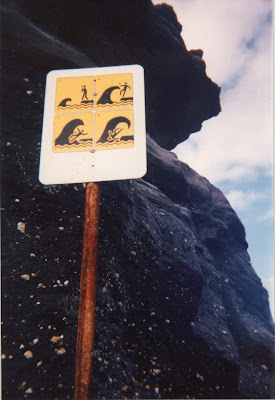
Another Funny Sign
In Hanauma Bay, Hawaii there is a path that leads to a lesser known Hawaiian attraction known as "blow-hole". Here, the waves come in to the rocky shore and force water into a hole in the rock. When the tide is coming in, the rock resembles a whale's blow-hole.
Further down this path there is a depression in the rocks that is the size of a hot tub. You can sit in this spot as it fills and drains with water. This is cool for kids and old people. The stuff for 20 year-old Marines full of testosterone and addicted to adrenaline is just a few feet to the right.
I cannot remember what this spot was called, but I still shiver when I think about it. It is a tunnel through the rock about 3 feet wide and about 20 feet long. It leads to the hot tub. When the hot tub fills up, the hole fills up. If you timed it right, you could enter the tunnel head-first as it began to drain again; the power of the ocean would pull you through the tunnel and into the hot tub. It took a matter of seconds to travel the tunnel, but it really had an affect on your adrenal system.
Now if you are really brave, you can try to enter the tunnel from the hot tub. The timing is trickier, the angle is more difficult, and you have to do more steering, but the payoff is worth it. It felt like an accomplishment, especially since there were those of us who would swim it backwards and those who wouldn't. We, the initiated, were made of better stuff I guess.
There were several times that I got too anxious and didn't time my push with the tide. When this happened, I stalled in the tunnel for a second and then began to be pushed back the way I came. Luckily, I had the lung capacity to wait it out and the mental capacity not to panic.
When the tide was weak, you could swim either way through the tunnel without resistance or assistance from the ocean. One time, I traveled halfway down the tunnel from the hot tub and bumped into someone coming from the hole. I was able to back up and pull her out, and we both had a nervous laugh. I shudder to think about how that could have turned out.
Kansas is a good place to live and raise a family, but I often miss Hawaii. There were holes to swim through, cliffs to jump from, sunsets that invented new shades of red and purple, rainbows on a regular basis, mountains, sweet air, and Mother Ocean. In Hawaii, I felt alive on another level.
Anyhow, on that path to blow-hole, the hot-tub, the tunnel, and oblivion, there was a sign. I like signs that are unusual. This one made me laugh every time, so I finally snapped a picture:
Friday, September 14, 2007
The Marines are Winning in Iraq (and so is everyone else).
In October, 1992, I began my training as a United States Marine at Marine Recruit Depot San Diego, California. I then attended Marine Combat Training and Rifleman training at the School of Infantry at Camp Pendleton, California. I then reported to Marine Corps Base Hawaii (then Kaneohe Marine Corps Air Station) for service as an infantry grunt in 2 platoon, India Company, 3rd Battalion, 3rd Marines, 3rd Marine Regiment, 1st Marine Expeditionary Brigade.
From October, 1992 to October, 1996 I was wholly devoted to war. I studied how to kill as a team and how to kill as an individual. I studied how to kill with indirect fire, volume of fire, controlled bursts, and single shots. I studied the use of aircraft, motorized vehicles, artillery, mortar, missiles, heavy arms, and small arms. I studied how to treat myself and others who have been hit with conventional, nuclear, chemical, and biological weapons. We learned how to control civilians, prisoners, and other uniformed services, how to respond to terrorist incidents, how to operate in snow, jungle, desert, urban terrain, and on the open sea.
It was a four-year, advanced education that I will never use. We came awfully close, but from 1992 to 1996 we were never called on by our nation to respond to a combat situation. I was prepared and enthusiastic about war, but I am also thankful I never had to go.
I miss the Marine Corps and a part of me wishes I was in Iraq. I also enjoy my civilian freedoms and love coming home to my family every day. It is a minor, inner turmoil for me. I have my ways of supporting my Marines in Iraq. One way is by following the 3rd Marine Regimental units as they rotate in and out of Iraq and Afghanistan.
Each Battalion has its own web page. On this page, the Commanding Officers communicate important information monthly to the families, they post photos of smiling Marines in theatre, they celebrate promotions and awards, and they post a memorial to the Marines who have fallen in service to their country.
This last item is something that affects me the most. As the units begin to lose men, I feel it--even though they are all total strangers. Each one of these guys look like guys I served with, or they look like me. They are fathers, sons, boyfriends, husbands, friends, bunkmates, and drinking-buddies.
It used to be that while a battalion was in Iraq, they would update their site every month with all of the above, but most notably with several fallen Marines. I always winced when I clicked on the link for Fallen Marines every month, but I had to do it. It reminded me of who the real heroes in this world are, and they deserve to be remembered by as many people as possible. The people of Iraq should be erecting a gold statue to each and every American who falls in their country.
Lately, I wince when I click on the links and I am usually pleasantly surprised to find that the roster of fallen Marines has not grown. I have also noticed that the daily news is not continuously reporting that a roadside bomb or sniper killed another soldier, sailor, or Marine. It seems the tide has turned in Iraq.
I want to make sure that this is said more often. Even though the news is not full of death tolls, it is still very negative about Iraq. There seems to be a lot of people who want Iraq and Vietnam to be synonymous. They are not; Iraq and Vietnam have huge differences between them. The biggest difference is that we have already won in Iraq, now we are just cleaning up. Victory was never so clear in Vietnam.
Last night, I finally had an evening to be a vegetable for a while; life has been incredibly busy lately. I intended to sit down and laugh at something mindless; I selected NBC's The Office from the menu. It was preempted by a message from President George W. Bush. The one time I have to relax, and my opportunity is thwarted by a president with whom I have several issues and disappointments.
It isn't often that our President broadcasts live so I listened rather than raged. I heard him say that we are winning, that the situation is improving, that the commanders have recommendations that he is following, and that he is interested in limiting our role, rather than maintaining or expanding our presence.
That matches up with my independent observation. It was sickening to see how our men and women were piling up for several years. It is motivating and encouraging to see that we now have the upper hand. My only concern now is whether the Iraqis can keep the upper hand as we send Americans home.
I think many people are not convinced that we are winning in Iraq. I think most of these people are unwilling to believe that we are capable of winning. These people are either hung up on memories of Vietnam, hung up on their hatred of Bush, or are simply dedicated to pacifism. All three states are understandable, but none of them are based on reality.
President Bush pointed out how we are winning in Anbar province. I had noticed that too. Anbar is the largest and most difficult area to control; however, through focus and intelligent strategy, our military heroes are accomplishing the impossible mission. The Shiites and Sunnis may not be skipping through the streets holding hands, but at least the killing has been curbed and the cooperation with Americans and Iraqis has become safer and more common. They are progressing and reaping the benefits.
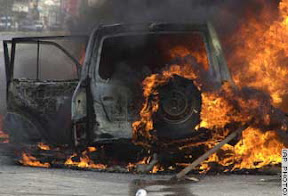
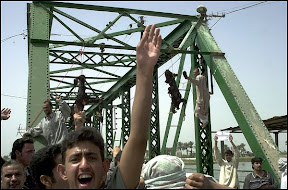
Has anyone heard of Fallujah? The first time I remember hearing of Fallujah was when several civilian contractors took a wrong turn going through Fallujah. They were ambushed, burned,
shot, beaten, dragged, and hung from a bridge.
The next time I heard of it was when we warned every civilian to leave the town and then swept through with several units, including the Marine units 1/3 and 3/5, of whom I have knowledge, history, and interest in.
I have read a little bit about Fallujah from numerous sources since then. By all accounts, Fallujah was always known as a place for crazies, even among Iraqis. If we were going to have trouble anywhere in Iraq, Fallujah would be the first place for it. It was expected that we would never have an easy time in Fallujah.
Recently, my battalion and America's Battalion, 3/3,
arrived at Camp Fallujah and began operations. They are on patrol on foot, in vehicles, and on Helos. That knowledge made me wince; India 3/3 at the heart of Crazy Central. However, it appears that Fallujah is a very different place today. Here is what the Battalion Commander, LtCol Nate Nastase
, has to say about the feeling in Fallujah:
Engaging the Iraqi Populace: While we discussed and trained hard for this aspect of the counter-insurgency fight during our pre-deployment work-up, nothing could have prepared us for the dramatic sea change we inherited upon our arrival. To put it simply, the local Iraqis have “come out of the woodwork” to join us in defeating the terrorists. For those of us who have been here before, this is a dramatic turn of events for the better. ... After years of murder and intimidation at the hands of the terrorists, the average Iraqis have said “Enough’s enough.” Our common goals have converged in a way that leaves little room for the insurgency to continue. And the attitude of “America’s Battalion” is contributing to the overall success of the mission.
When I read columns from the New York Times, I get the mental image of a melancholy foot patrol dragging their rifles behind them as they dejectedly wait to meet their inevitable fate. Or I get the image of men who put on a stoic face for the camera and then when the cameras are put away they bash Bush and wish they had never been tricked into joining the military for college money. If any single veteran (or parent of a veteran) speaks out against the war, their face is soon filled with microphones. Yet if any of the hundreds of thousands of men and women who have served in Iraq want to explain why they think the mission is important and winnable, they are usually left alone with crickets chirping.
Not enough people who control our national message are willing to portray a positive message regarding Iraq. I am tired of it. I want to win. I want to think positive. I want to be proud of my country. I want to face a future of peace and prosperity. Do we really need to skew the message to make it doom and gloom, with America as the oppressive loser? Do we really need to force a loss so that Obama or Clinton-2 can get elected?
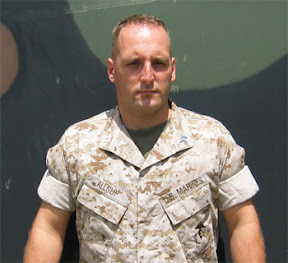
I want to post the September message from India Company's Commanding Officer, Captain John Allsup
, in its entirety. His messages are well written and organized, succinct, and gives a feeling that the Marines and Sailors under his command are proud volunteers who are willingly and enthusiastically accomplishing their mission. Every message from commanders in Iraq will necessarily be upbeat and optimistic; what kind of fruitcake would write home to his subordinates' families with doom and gloom? Even so, it is hard to fake sincerity, and word choice is important. If you go to the 3rd Marine Regiment's website and read the messages from all the commanders, you will find them all upbeat. However, you will not hear the same message. Each commander has written his own personal message; this is not a directed effort containing the same key phrases and vocabulary.
Capt Jessup's Message:
Greetings from Camp Fallujah Iraq to all the friends and family members of India Company’s Marines and Sailors,
The company is currently conducting Civil Military Operations in our area of operations southeast of the city of Fallujah. Things are pretty quiet in our area and the Marines and Sailors have accomplished much in providing the citizens here with security, basic essential services (power, water, sewage, etc.), schools and a governing body. What our company is accomplishing here is the end state of all Coalition Forces in Iraq: to help the Iraqi people achieve independence from relying on Coalition Forces. Once the people here can provide their own security they can begin rebuilding their nation. Your Marines and Sailors are performing magnificently and each man is helping to achieve these things.
Since getting here we have been extremely busy. We are nearing the end of our first month and the Marines and Sailors have adapted to the environment and the separation from their families without any major complications. It is regularly greater than 120 degrees so everyone is looking forward to cooler days in the fall. I am happy to report that no one in the company has been injured or seriously ill. A few cases of heat rash and some heat exhaustion have been the greatest extent of our injuries. I am confident that because of their training and attitude this will remain the case throughout the remainder of our deployment. My compliments to all of our junior leaders and corpsmen who have done so much to ensure everyone stays healthy.
Many of the wives and girlfriends have been asking exactly what it is that we are doing day to day over here. I mentioned in the beginning of this newsletter what the mission of the company is, but I did not talk about the tasks that the Marines and Sailors are accomplishing. Without getting too specific I can report that the Marines and Sailors are doing a lot of foot patrols with many various missions (the heat and heavy gear make this extremely difficult). Many of the patrols, as mentioned earlier, are helping the population of our area rebuild their communities. Your Marines and Sailors here love the children. It makes me proud to watch them with big goofy smiles on their faces handing out toys, soccer balls, books, crayons and candy to a group of children. Then five minutes later they are all business - grim faces constantly alert for any sign of danger. Our Marines understand their mission here. “The Iraqi people are not our enemy but our enemy hides among them.” They balance friendliness and watchfulness with magnificent maturity. They are the true protectors and friends of a group of people who have endured countless years of terror and strife. I am so proud of each and every one of them – you should be too. Regardless of what you see and hear on the news, know that your Marines and Sailors are succeeding here. They are winning. They are making a difference.
Many families are asking what they can send in care packages. In case you did not know, we have a PX here so many of the basic necessities are available. Batteries, toiletries, snacks, and even electronics can be found in abundance. However, packages are always nice to receive so I am sure anything you send will be much appreciated. It typically takes 10 days for mail to reach us, but there is an alternative for letters and pictures. If you have access to the internet, go to Google and search for “Moto Mail,” go to the web site, create an account, and you can type letters and even include pictures which will reach your Marine or Sailor within 24-48 hours. Unfortunately it does not work from us to you. As the Marines spend most of their time out in the community and do not have access to e-mail this may be the best way of dropping them a line.
I am extremely pleased with the teamwork, camaraderie, mental toughness, bravery, and self-discipline the Marines and Sailors have been displaying during these past few weeks. Their aggressive warrior-spirit feeds off of the confidence they received from outstanding training, and has transformed them into disciplined professionals. During the long months ahead, this very spirit is what will sustain them and drive them to accomplish great things for each other, for the Iraqi people, and for all of you. In my last newsletter I stated that your Marines and Sailors will make a significant impact on the current world situation and as such theirs is the greatest of responsibilities. This has held true and will continue to hold true in the months to come. They are the finest fighting men in the world – they are highly trained, truly motivated, and dedicated to a higher cause of world citizenship. They are the defenders of the weak, the helpless, and the abused. I could not be prouder of them as men, as citizens, or as Marines. I am truly honored to serve them and I hope that you are as proud of their character and accomplishments.
I have written a few of you letters and I will be sending more as time permits. Please do not hesitate to contact me directly (snail mail or e-mail) with any questions or concerns you may have. I am here to serve your Marines and I will never be too busy to address any concerns their families may have. I also want to take this opportunity to thank all of you for your overwhelming support of the company and everything you have done for your Marines, Sailors and for the unit as a whole. Being a family man myself I know how difficult this deployment is for all of you. My thoughts and prayers will continue to be with you and the Marines and Sailors of the company. God Bless and Semper Fidelis.
Capt John Allsup
India Company, 3/3
Last updated 6 September 2007
Friday, September 7, 2007
Loyalty
I have often wondered about the concept of loyalty. As a Marine, we were taught to be supremely loyal (our motto Semper Fidelis is Latin for "always faithful"). We were also reminded of times when we would have to disobey orders, such as the soldiers in My Lai, Vietnam should have. I really had trouble with the concept of when to disobey and appear to be disloyal because war contains so many gray areas. Also, the consequences of disobedience are deadly. Perhaps that is the excuse of some of the Marines from 3/5 who followed their squad-leader in Haditha, Iraq that allegedly killed innocent civilians--they were torn between loyalty and morality.
Even today, there are times when I wonder if I should be more loyal to my customers or my corporation. Loyal to my boss or to my corporation? Loyal to myself or to my company? Loyal to my wife or my mother?
Mark's blog has produced a tangent that I would like to include here: a surface analysis of loyalty. I do not know that I can do more than graze the surface on a subject that can cut so deep and requires a broader experience than I possess. Even so, loyalty is a subject I must face often, as well as teach to my children and nephew. Therefore, I might as well get started now cleaving the fine points of loyalty. Perhaps I by analyzing it now I will have a better grasp of loyalty when I really need it.
Loyalty, it is argued by many, is a binary condition: either you are loyal or you are not. There isn't a gray area of loyalty according to conventional wisdom, and there isn't a reliable method of choosing when to be loyal, or not to be, that everyone would agree with. If I asked my father or barber, they would counsel me that I should be totally loyal to the institutions that I benefit from: my family, my company, my church, my nation, etc.
However, we have all seen what happens when we are blindly loyal: I think Nazi Germany is the most popular and best example of misplaced loyalty. Even in America, we cannot be expected to be loyal without negative consequences. My company has laid off loyal employees, families have been known to do horrible things when inheritance or scandal is on the line, our nation drafted boys for Vietnam even though they never intended to win the war (nor should we have been there in the first place), and churches...well, don't get me started on that. You know what loyal religious zealots can do, regardless of what name they give their deity.
Perhaps Shakespeare grasped the essence of the right kind of loyalty: "To thine own self be true." This is the kind of loyalty that I have clung to so far in my life, and I do not think it has proved to be a shallow, selfish loyalty that leads me to rationalizing unethical behavior and disloyalty. You may predict that a loyalty that is based on situational ethics is bound to be imperfect. I would argue that all loyalty is bound to be imperfect, but situational loyalty based on personal values that are aligned with societal mores is the most accurate loyalty we, as humans, can muster.
Benedict de Spinoza argued that the highest virtue of man was to know God; this knowledge would make us ethical. He argued that God is always ethical because that is His nature to be so: everything God does is right because He embodies what is right. According to this argument, the more we know God, the more we will desire virtue and our actions will begin to match God's ethics. The end result of knowing God is to imitate His nature. If everything God does is considered ethical, and if we know and imitate God then everything we do will be ethical too.
Spinoza goes on to argue that if we seek our own desires, we will conflict with the desires of other men seeking their desires. We will be hated and opposed in achieving our desires, which is obviously contrary to an ideal life. However, if we are all seeking God's desires, we can all be happy. We can help each other, receive help, and all end up equally receiving our share of the one desire.
I lean towards agnosticism, or at least Christian cynicism of some sort. Even so, I can follow Spinoza's logic most of the way. I believe that we can all agree as a society on some level of moral absolutes (against stealing, killing innocents, etc...) If we are examining our life and our society, as well as ourselves, we will know instinctively when loyalty is called for and when you should blow the whistle.
Also along Spinoza's reasoning, I think most of us are fairly honest and try to do the right thing for ourselves and our society. I have accidentally left my car unlocked with CD's and electronics visible and been glad to find them unmolested. If we are seeking to do what is right and in the best interests of ourselves, which includes doing what is best for the objects of our loyalty, then we will know where to cleave the limits of loyalty.
For instance, as a Marine I hope I would know at the necessary time that shooting unarmed civilians is actually disloyal to the Marine Corps. In the end, I should know that such an action is not only morally outrageous but it will damage the image of my beloved Corps and my nation, as well as my family and myself. Therefore, even though resisting the order to fire is disloyal to my squad leader and unit, it is an act of loyalty to all Slobodzians, all Marines, and all Americans.
We could even carry this further to say that shooting unarmed civilians is disloyal to the human race of which we are a member, and that disloyalty will have a direct, adverse effect on me (besides a blackened soul, I will enjoy less stability and more animosity. I may lose my life or a friend's life in revenge for the killing of an unarmed civilian). It would be better if our starting point was here at the highest level, but as humans we tend to be loyal to the lowest orders first.
I plan to talk more on my blog about how we are all symbiotic. At this point, I would like to define symbiotic as the state of interdependence; we all need each other; when we help each other we help ourselves; when we hurt someone else, we have hurt ourselves. The dictionary calls it symbiosis, but I am creating the word Symbioticism to define a philosophy I am developing.
For the subject of loyalty: if we understand Symbioticism, we realize that we act in our own interest when we help others. Therefore, if we make a decision with Symbioticism in mind, we will always be loyal to a higher order, even if we must be disloyal to a loyal order. Moreover, we know that if we choose a cowardly loyalty over known morality, then we have harmed ourselves as much as if we had polluted our own drinking water. The Germans should have known they were not better off by exterminating the Jews; they lost many of their best scientists, logisticians, and entreprenuers when they "cleansed the race".
I agree with Spinoza's reasoning: If I am a bad person, then I will make a bad decision when faced with a crisis of loyalty. If I am a good person, then by definition my actions are usually good; as much as is humanly possible. The result will be a right decision when faced with a crisis of loyalty: though I may choose to be disloyal to a certain organization or institution, I will have chosen rightly and it can be considered loyalty to a higher institution.
Now if we could all just agree on what is good and bad (what is quality?) in every situation.