Showing posts with label Fathering. Show all posts

Sunday, December 28, 2008

Letter to Kate DiCamillo

Dear Ms. DiCamillo,

Thank you for your books. I have been reading them to my kids, and I couldn't have chosen a better author's work. We started with The Tale of Desperauex and followed it up with Because of Winn Dixie. Last night, we finished The Miraculous Adventure of Edward Tulane. We will soon be looking for your other works, and eagerly await a new book.

I loved Despereaux. It was a story that any age could appreciate, and I appreciated the way you introduced a few rare words and explained their meaning with both a definition and then an example in the story. You are not only making my kids smarter, you are making me smarter as well. Thank you.

A few days later, I was reading (alone) about Da Vinci, and the author described Da Vinci's dark/light contrasts as "Chiaroscuro". I found elsewhere that chiaroscuro can be used to produce depth and dimensions in light. To transpose those concepts from art to your story made so much more sense, and I have to tell you how impressed I am by the layers of your story. I am sure that if we reread the book again we will be pleasantly surprised with details and ideas that we missed before.

We went to the movies to see The Tale of Despereaux, and I was sorry to see how they changed your story. The kids were disappointed, too. I understand the need for small changes to translate a story from book to film, but I think they unnecessarily changed the most valuable aspects of your story to "dumb it down" for the movie-goer.

Winn Dixie was a great read, and the underlying values that can be learned are exactly what I want my kids to learn. Thank you!

It is rare for me to cry. Every once in a while, a movie can get to me. I can only think of one book that made me cry before reading about Edward Tulane. That other book was a biography of Carl Sagan, and I cried when he had to say good-bye to his kids before he died prematurely. Your book made me cry twice. I cried about Sarah Jean, and then I cried as Abilene and Edward meet again. Actually, I almost lost it while reading the Coda. My kids had never seen me cry, and they didn't quite understand it, but I think it was a good experience for them. Now they know I'm not as tough as I pretend to be.

More importantly, the lesson of Edward Tulane is of the most important lessons in life (top three lessons, for sure.) It is also the most difficult to put into words, and oftentimes our actions are not enough to teach this lesson. Unfortunately, many people must learn this lesson the hard, just like Edward.

The antique doll had a great many stories to tell, didn't she? With that much time on earth and that many cracks in her china, she must have a treasure trove to pull from when she needs to remind herself that she has been loved, that she has loved, and that life can be really good if your let it.

I can't help but wonder where Bryce went. I wonder what lesson Bryce can teach us? When he is forty years old, is a successful and generous man (a Jean Valjean) or a miserable and bitter drunk reliving his father's life?

Thank you again, Kate DiCamillo. They tell me that reading to my children will pay untold dividends. I am sure that those dividends are multiplied when I am reading your books to them. May your muse continue to inspire you with great tales, great values, and great wordsmithing.

Happiness

Of course, I want to teach my kids everything I know: especially the knowledge I gained the hard way. But what if you could only teach them one thing? [Don't focus on why you can only teach them one thing, just humor the exercise and isolate the most important thing you know.

I found this aphorism from Michel de Montaigne that captures the one thing I think my offspring need to know:

The man who is happy is not he who is believed to be so but he who believes he is so. (Geary's Guide to the World's Greatest Aphorisms by James Geary, page 128.)

If I had known this principle as a younger man, I could have wasted less time and focused more on lasting happiness. The quick-fix happiness I sought in booze, girls, games, food, TV, and many other trivial pursuits did not return anything over time.

Imagine your happiness is measurable. Your happiness starts at zero, and you have a beer to push it up to a "1". After six beers, are you at a happiness level of "6"? Maybe, but there is a law of diminishing returns that applies here. At some point, you have one too many beers. The hangover itself will sap your happiness level, and that is in addition to any errors of judgement you may have committed while intoxicated. No matter what, you always lose the happiness that each beer brought. Beer/Food/Drugs/etc do not leave a residual happiness, they wear off.

Reset your happiness meter and lets try another exaple. Starting at "0" you turn on TV and find a new episode of your favorite TV show. Happiness level soars to a "10" while the show is on, drops to a "5" immediately after, and then registers a zero once it has left your short-term memory. If you were supposed to be doing something else instead of watching TV at that time, then the drop off will be steeper and deeper. TV does not produce a residual happiness.

Now a better way, in my opinion: Do something for a relationship that you don't feel like doing. Give a back rub, cook something that you don't like but that person does, listen to a boring story enthusiastically, or let them control the TV remote tonight. The happiness meter starts at zero, plunges into negative numbers for a brief time, and then slowly climbs to about a "2". Two years later, you recall a time when you did this selfless act and find that it still provides a residual level "2" happiness. If you can amass an impressive history of selfless acts, you will notice two things. First, they add up to a higher level of residual happiness (which means they cause your happiness to sit at a constant level "10" or higher, even in the darkest of times. Second, the object of your selfless acts will probably reciprocate, which both spikes your happiness and raises the residual happiness level.

My young kids can't really learn it yet. They have a lot of living to do before they know how true this aphorism is. Therefore, the best way for me to teach them now is by my example. I hope they see me working on my happiness, and actively choosing happiness. I hope that they intuitively choose happiness, regardless of what their friends say or what conventional wisdom has decided. I hope that they see the difference between short-term happiness and long-term happiness.

2009 may be a really hard year. If it is, I think I am ready to be happy anyway. I am hoping that everyone is surprised by how well 2009 treats us, and that happiness comes easily. If not, I plan to keep investing in those long-term happiness builders that I find with my kids, wife, extended family, charity, and self-improvement.

I hope your 2009 is filled happiness! Thanks for reading my blog.

Saturday, January 19, 2008

Watch D.O.G.S.

I have been looking for an opportunity to donate some of my time, in addition to donating money like I talked about last time. Of course, finding a place to donate your time is easier than finding a job. However, I have found it twice as hard to find an opportunity that matches my skills, passion, and time.

Recently, I found an opportunity that was a perfect match. At my daughter's school, they have a program called Watch D.O.G.S., which stands for Dads Of Great Students. The idea is to have a dad, grandfather, uncle, or stepfather spend a day at the school, and their presence both adds to the educational experience and increases the security of the school. According to the official website:

WATCH D.O.G.S.® is the safe school initiative of the National Center for Fathering that was founded by Jim Moore, a concerned father who chose to take action in response to a 1998 middle-school shooting in Jonesboro, AR.

My day as a Watchdog Dad was fantastic, and I will be doing it again soon. Let me just say now that if you have any kind of fatherly influence on a middle school child, you should look into joining or starting a Watch D.O.G.S. group. Every man who participates will have more fun than they could imagine, the kids have a great time and receive a new perspective, and the teachers and administrators benefit from the extra eyes, ears, mouth, and hands to both educate the kids and keep them safe.

I began my day by receiving an official vest that identified my role. I was then asked to stand out in the parking lot to observe the kids arriving. I have been a parent dropping off and felt the frustration of having to queue and move slower than I'd like. I have also wished there were more adults, preferably police, present at the beginning and end of the day when kids are most likely to be shot, run-over, or kidnapped. It was gratifying to be a part of the safety net that keeps the kids safe.

After morning announcements, my daughter and I had our picture taken for the WatchD.O.G.S. board, and the girl got to wear a T-shirt all day to identify her as the kid of a Watchdog Dad. She then went about her day and I was given an itinerary to follow.

My first stop of the day was in a kindergarten classroom. The teacher was previously my daughter's teacher, so we knew each other. She sent the kids with me one at a time to the hall where they read a little book to me. It was interesting to me to see who had the book memorized, including the teacher's voice inflections and gestures. Some of the kids could sound out the words that they were unsure of. The best was one child who would recite the memorized sentence in the book and then offer her own commentary on the story. I was laughing, which only encouraged her embellishment. I can't wait to read her first novel.

Most of the kids were a little standoff-ish because I was a stranger, but they warmed up a little and read the book. However, there were two kids that were unwilling to read to me. They didn't look at me, and they either did not respond to my questions or they mumbled an answer. I wondered if they have more anxiety with strangers than most people do, or if they are used to dangerous and abusive men. It was difficult to see kids with so much to deal with at such a young age. I can't imagine how teachers who see that thing everyday are able to deal with the sadness and frustration that these kids made me feel.

And that reminds me of the kids I saw coming in after the first bell. A teacher was stationed at the front door to sternly announce to each tardy child that they were late and they needed to hurry to their classroom. The oldest kids coming in were in sixth grade and the youngest were kindergartners. I like the idea of teaching kids to be responsible and punctual, but I wonder how much responsibility a sixth-grader can take for their transportation to school, let alone a kindergartner.

More than one of the kids coming in were crying, and many of them looked unkempt or disheveled, indicating to me that the parents have issues of their own. I wondered if making these kids feel bad about their tardiness was productive, but I also see the value in making the tardiness an undesirable condition to be avoided. It is too bad the school can't do more to punish parents for tardy children, and hold parents responsible for more of their child's education.

Teaching my children to read, write, add, subtract, and act with morality and responsibility is a no-brainer for me and my better-half. Unfortunately, my wife and I find that many of our child's peers have been left without any training or worse, they have learned about sex and violence at a young age without learning how to spell their name, hold a pencil, or count to ten. A few of the children are left with not only a lack of fundamental skills but also a lack of English. They arrive in school with only as much English as they can learn from T.V., which makes the teacher's job that much harder.

My daughter was ready to read in kindergarten, but her teacher was prevented from spending time cultivating that skill because she was still teaching the alphabet to kids who apparently received more than enough calories at home, but not enough Sesame Street or parental tutoring. They could recite the lyrics to Snoop-Dogg compositions, but couldn't remember what came after t-u-v in the alphabet. I understand that there are all kinds of issues out there and I have experienced a few of them. However, I can't imagine how having kids wouldn't cause you to find a way to rise above your issues and give them a better future than you had.

After a long, hard day, I had an hour or two that I could spend with my daughter and a book. On the other hand, the teacher had my daughter for several hours (she also had the education and experience to more effectively teach reading skills.) I know that she would have loved to help the best students go farther, but she was limited by the weakest link in the chain. I certainly wouldn't want any child to be seperated as "slow" or "dumb" at such a young age, but I also can't help but wonder how much farther along my daughter would be if she had been challenged more, rather than waiting for the other kids to catch up.

Just to be clear, I don't want to paint my daughter as the star pupil. There were several students like her who had the skills and willingness to do more than was asked of them. A clear divide existed between the students who had been worked with, and those who had been left without instruction. Perhaps we need to increase access to quality pre-school, or just start slapping sense into some parents. I know, the former idea is more acceptable but the second option would be more satisfying.

Anyhow, back to the story: After kindergarten, I headed to fourth-grade where I was read to again. The kids were bigger and more skilled at reading, and the books were much more interesting. I could ask the kids about the books they were reading to test their comprehension, and I could explain concepts and definitions to help them comprehend more. It was very interesting to experience the contrast and see how much a kid learns in just a few years.

Throughout the day, I was greeted warmly and enthusiastically by many kids and adults, which is a great change from my usual day. In my career, I usually meet people who expect me to either fix sopmething or try to sell them something, and usually both. I work in an industry full of gruff, bitter, and burned-out people. Needless-to-say, it was a fantastic change to have everyone happy to greet me without any expectations.

After fourth-grade, I spent 30 minutes observing a kid use a computer to enhance his learning. This was a child who was obviously below his age-group's reading level and was working on phonics. I do not know if anyone is to blame for his difficulties, and it is none of my business. I am just glad that his condition was diagnosed and that he is receiving the extra attention he needs. In other school districts he may have slipped through the cracks, but here he is taken out of the class and brought up to speed with special attention by literacy specialists. Even better is the use of techonology; with a moderately-priced computer and internet access, these kids are getting opportunities that were previously unavailable. Using computers to take the place of instructors, you can get more attention and instruction to more kids who need it.

I got to go out for recess for the first time since I was in grade-school. It is still awesome to run free on a muddy field and play football with the boys, even when it is 30 degrees. I think more adults should experience recess again and be reminded of how exhilerating and liberating it can feel. If we could incorporate recess into our work day, like Spain incorporates the siesta, we would have more productivity and less heart-attacks I am sure. Rush-hour would be less tense everyday as well; we would be too tired and happy to honk or flip eachother off.

I got to eat lunch with my daughter and her friends, and that was waaaaaaay better than eating lunch with my friends. I was grossed-out just as often, but the topics of conversation were much more fun and uplifting. When you are in grade-school, everything is fun, funny, or new. Burps are great, trading carrots for a cookie is the bomb, and no one cares who Hillary Clinton is or whether gas prices will break $3. I wish I could eat at her school everyday; I am sure it would make my life more satisfying and I may squeeze a little more productivity into my afternoon.

When I drop-off or pick-up my kids from school, I will be more patient now that I have seen how hard it is to control the chaos. I have been critical of teachers in the past; now that I have seen a full day and all the issues that need to be addressed, I will be unable to criticize these heros. It is too bad that our society does not value our teachers more; we have no idea what we could get out of them if we spent more time encouraging and enabling our teachers, rather than criticizing and cost-cutting. Shame on us.

Originally, Watch D.O.G.S. was started to increase safety in our schools. As a Marine, I can confidently report that my presence made the school safer that day; luckily, that safety was not tested. Perhaps, just knowing that there is a dad at school everyday will prevent many unsafe thoughts from occurring to desperate minds. Failing that, it is good to know that there will be more eyes, ears, and muscle to prevent bad situations from being worse.

This is a program that everyone should be aware of. If you are a fatherly figure, you really should get involved. If you know a fatherly figure, please pass on this program. If the school does not already have a Watch D.O.G.S. program, it can be easily started-up by clicking here. This is a fantastic opportunity to give back to your community, spend more time with your kid, and have as much fun as a grade-schooler. If nothing else, it gets you out of work for a day, and that is always a good thing!

Thursday, September 27, 2007

The Kind of Work I Do

It has already been established on this blog that I am messy by default. My desk, room, garage, workshop, and van were in a constant state of disorder. I have gone to great lengths to improve that, but without medicine and constant vigilance, I would resort back to my natural state.

However, I am neat when it counts. When I leave a customer site, I leave it better than when I arrived. I learned that in the Marine Corps: when we stopped in the field for a while, we always removed evidence that we had been there before we left. When we setup in a non-tactical area of operations, we would clean up litter that was there before us. In Iraq, the Marines make sure that they leave a town with more water, schools, and soccer balls than when they arrived.

I have a strong work ethic. I get it from my father. He taught me that a job worth doing is worth doing right. That has a lot of depth to it. There is existentialism written all over it. Would you and should you do a job that isn't worth doing? Why would you do a job that isn't worth doing? What makes it worth doing? And if it is worth doing, why would you not do it right? What is the point of having a job that is truly worth doing and then doing it wrong or only doing half the job?

I exist to work. I do not exist to earn a paycheck, or to make an employer rich, or to call myself by a title. I exist to do something. That something is defined by me and it transcends "jobs", employers, salaries, and titles. At the end of my life, no one will care what server I saved or which router I installed. If anyone cares at all, they will care how I did more than what I did. That includes how I treated people, whether I conformed to the big picture or not, and what effect my existence had on the my sphere of influence. Did I leave the world better off than when I found it or did I leave a mess for someone else to clean up?

In August of 1997, I had been out of the Marines for a year and was still trying to find myself. I was working for a Pepsi distributor at the time, which was a low paying job with no benefits but the best job I could find at the time. I traveled to grocery stores to fill their shelves and build displays.

I was the most junior guy on my team, which meant that for a long time I did not have my own regular stores; I filled in where I was needed. On August 13th, my boss called and offered me my own route. The guy who had the route was getting fired for performance issues. Getting my own stores was a proud moment for me. Mainly, it meant that you could always go to these stores to see how well I did my job.

The first store on my route was the Price Chopper in Stanley, KS. I arrived at 6am on August 14th, 1997 as proud as could be. As soon as I walked into the backroom, I was greeted by the manager of the backroom. He was an old man whose life did not turn out the way he had dreamed and he took it out on everyone around him. He chewed my ass for the condition of his store. I explained that the person responsible had been terminated and that I was the polar opposite. I agreed that his store was atrocious, and that it required my top priority.

I should have delivered by speech to the brick wall; this guy just wanted to be an a-hole. I will never forget how angry he made me by assuming I was another slacker. I considered telling my boss. I considered telling his boss. I considered breaking his fingers. I considered ripping his tiny little heart out of his chest and stomping on it. I was a little angry.

His biggest complaint was the pile of damaged Pepsi packages. We were supposed to repackage as much as we could and then make a safe and secure pallet of the unrecoverables to ship out. It was dirty work: the breakers were often covered with sticky spray from a punctured can, as well as the grime that accumulates quickly in a backroom.

Taking care of damage was also time consuming. You had to locate new packaging and box tape, then clean the product, then build a package one can at a time, etc... It could turn a ten hour day into a twelve hour day. It could also make you late getting to your next store, which would result in another ass-chewing by that manager who was angry about life, his two ex-wives, his daughter's tattoo, and the lack of Pepsi on his shelves.

The damage at Stanley Price Chopper had built up for a long time. The backroom manager was sick of it, and he was not going to give me a fair chance to correct the problem. He pulled out a Polaroid camera and took a picture of the pile to show my boss:
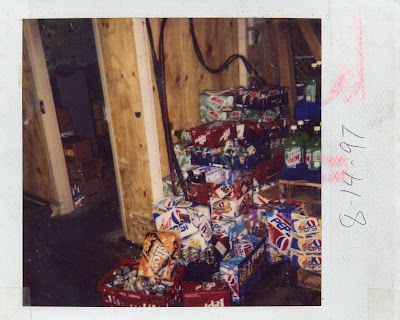
I love a challenge, and this guy had thrown down the gauntlet. I knew that I wouldn't be in trouble for this mess; it wasn't mine and my boss knew it. I knew it was a low-priority for my boss; my higher priorities were filling shelves and building displays for several stores. I also knew this backroom guy barely mattered: he did not make purchasing decisions and he would give himself a coronary any day. However, this was a chance to rise above average, to prove to myself and anyone else watching that I had something more inside of me than a $10 per hour manual labor job. I had a chance to make myself proud, and maybe someone else along the way.

On 8/14/97, I worked hard. I left the Stanley Price Chopper with full shelves of product (all facing forward), well constructed and attractive displays, and full vending machines-but the backroom still looked like a disaster. I had five more stores to worry about.

I arrived at other stores that had suffered similar neglect, but I was not met with the same ferocity that greeted me in Stanley. It was long day of heavy lifting, working my way down crowded aisles of oblivious shoppers, driving down crowded roads of oblivious drivers, and plenty of tedious labor. After I finished my route, I returned to Stanley. By now, I was all alone back there and could work in peace. I cleaned up the mess, made my rows of Pepsi neat, and left the store exactly the way I should as a conscientious and proud merchandiser. Then I went looking for a Polaroid.

I asked the young girl at the front counter about the camera, and she found it easily. I think I told her I needed a picture of a product display or something, but I doubt she really cared. I took two pictures of the scene below:
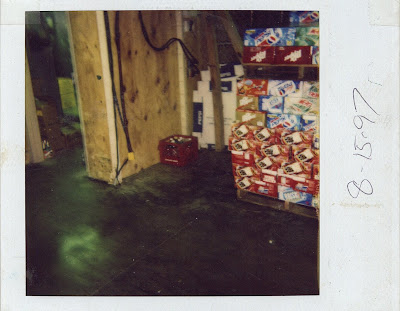
The backroom manager had pinned the photo of the Pepsi mess next to his desk to remind himself the next time my boss came by. I stole it; I am not proud of stealing, I believe it is always wrong, and I do not endorse situational ethics. Even though the backroom manager was wrong for holding me accountable for the damage, I was wrong for stealing the photo. I am sorry. In any case, I did it. I replaced his messy photo with a photo of the clean spot.

Nothing ever came of this. I never had a run-in with the backroom manager again; I think I avoided him for the sake of sanity and to not have to answer for the stolen photo. I wish I could have been there when he reached for the replaced photo. Was he bewildered? Did he expect me to do this? Did he care at all, or did he just shrug, mentally check Pepsi off his hit list, and move on to the Milk guy? Did the Coke guy suffer more because of me?

It is over ten years later, and I still remember the incident, I still have the photos. On 8-14-97 I wanted to kill a man. The Marine Corps was still fresh in my psyche then: the pride, the training, the instincts. I was really angry at the time. I was able to keep my wits and suppress my angriest reactions, but it wouldn't have taken much for me to snap and splatter that old crotchety never-has-been.

On 9-27-07, I want to thank that man. Shame on me for my anger and thoughts of how to extend his suffering. He did me a great favor; he brought out the best in me. I would have done a good job in Stanley's Price Chopper over time, and that damage pile would have shrunk slowly, but surely, over several weeks if he had left me alone. By attacking me, he forced me to find a way to do my job better.

Moreover, he gave me solid evidence of things inside of me that many people do not have in such quantity: a great work ethic, personal pride, capacity for work, and high standards. I already knew I had those things; I had proved them before. My Marine Corps service was a certificate in such things. However, this was one more bullet point to help me know who I really was: a proud man who goes above and beyond, who gets "it" done, and who holds himself to a higher standard than those around him.

I keep these photos to remind myself of the kind of work I do. I get tired. I get discouraged. I get my feelings hurt by employers and customers. I get sick of the crap that employees get dumped on them over time. There are times when I feel like a bad employee, or I feel like I am incapable for doing anything right. These photos remind me what I am feeling is a temporary reaction to a temporary situation. The static reality is that I am a great employee who makes the impossible happen and I exceed expectations any time I want to.

Thank you, grumpy old man. You made me better that day. You have made me better every day since with the photo you took. When I remember you, I work harder and do it better. I can only hope that I have that effect on someone else with my life too.

And I want to thank my dad even more. I have had many lessons in work ethics, but without solid fundamentals I never would have gotten "it". My dad did three great things in raising me that have made me a great employee: First, he made me work. I am used to hard work, I have a greater capacity for work, and I expect to work hard because my dad made me work while other kids were playing or sleeping. Second, he made me do the job right; he corrected me when it was wrong and showed me how to fix it. By setting the bar high and teaching me that, "A job worth doing is worth doing right," my dad gave me an advantage over the people around me.

Third, and most important, my dad worked hard himslef. He did well and got promoted at work. He worked hard at home on maintenance and improvement. He worked hard in the community on various projects such as the Jaycees and the zoning board. He worked hard on me, even when I was a hopeless lost-cause. That example makes the difference. Words are one thing, but actions make a lesson stick.